
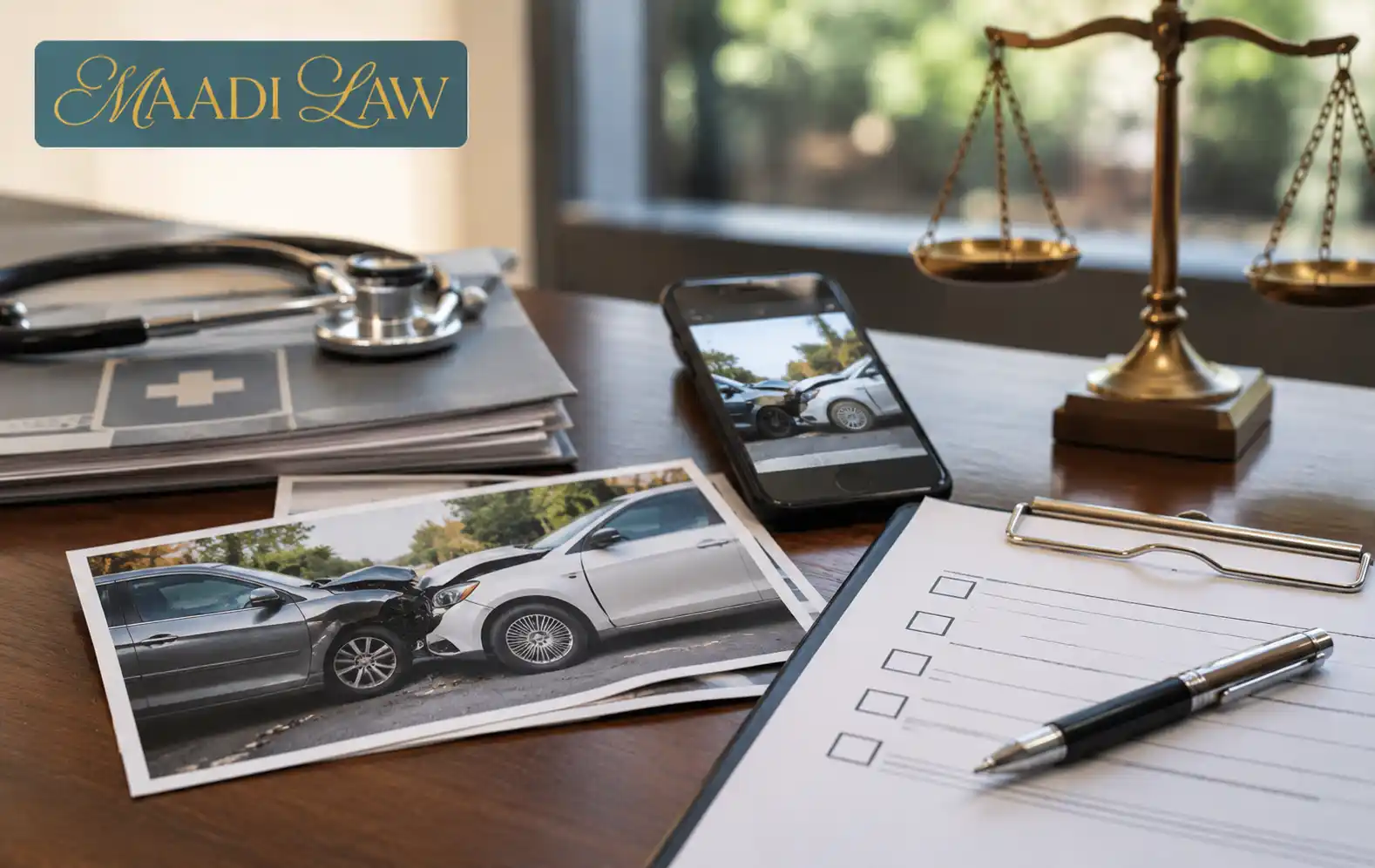
Right after a crash, everything feels obvious. You know what you saw and how it happened. Months later, that certainty is much harder to prove. Footage disappears, memories soften, and the details that seemed impossible to forget start to slip.
At Maadi Law, we think of evidence in a car accident injury claim in Orland Park as a race against time. Some evidence lasts. Some starts slipping away long before any deadline arrives. Knowing which is which helps you understand why the first weeks after a crash matter so much.
Sorting Car Accident Evidence by How Long It Lasts
Not all evidence remains available for the same amount of time. Camera footage, vehicle data, and witness accounts may become harder to obtain, while medical records and wage documentation help explain the effects of an injury. Understanding these differences can help you see why gathering evidence early matters to a car accident claim.
Two clocks start at the moment of the crash
Illinois generally allows two years from the date of a crash to file a personal injury lawsuit, although exceptions and different deadlines may apply. That's the clock most people hear about. The second clock runs much faster. Camera footage, vehicle data, and witness accounts can play an important role in a car accident claim, but some of that evidence may become unavailable long before the general two year filing deadline.
When we talk about acting quickly, that second clock is usually what we mean.
Footage and vehicle data: the record nobody has to remember
Camera footage and vehicle data can provide information that does not depend solely on someone's memory of the crash. That's what makes this kind of evidence so useful. It's also why losing it hurts. Neither one waits for a claim to get started.
Most of the serious crashes we see in Orland Park happen on a handful of corridors. On La Grange Road, that means left turn collisions across multiple lanes, rear end crashes on the backed up approaches to the shopping centers, and drivers moving faster than the signals allow. When a crash happens in that kind of traffic, an objective record of the moment can carry a lot of weight.
Witnesses remember the most at the start
Witness memory sits on the same short list. Someone who saw your crash may describe it clearly this week. Months from now, some details may be harder to remember. That's why witness statements are worth securing while memories are still fresh.
The crash report is the foundation, not the whole story
The crash report is the foundation of the claim, and you're entitled to a copy from the agency that responded. Still, a report is a starting point. When you hire us, we obtain it and read it against the physical evidence to see how the two line up.
Evidence of what the crash cost you
Showing how a crash happened is one half of a claim. The other half is what it did to you afterward. A serious crash leaves medical bills and missed paychecks, so your medical records and a lost wages statement from your employer belong next to the crash evidence. Unlike footage that may be lost, medical records and wage documentation can provide a continuing written account of treatment and time missed from work.
Let's protect what can still be found
You don't need every piece of evidence in hand before you call us. You just need to call before the fragile pieces are gone. We take over every detail of your claim so you can focus on healing, and Sharif Maadi and our team at Maadi Law want to hear what happened while that evidence can still be found.
Call 312-312-7558 or use our Tell Us What Happened form to reach Maadi Law. A free consultation can help you understand the deadlines that may apply to your case, but it does not extend the time allowed to file a lawsuit. There's no fee unless we win.
FAQs
Do I have to gather all of this evidence myself?
No. Once you hire us, we obtain the crash report, review it against the physical evidence, and communicate with insurers about your claim. You can discuss the evidence available in your situation during your free consultation.
What if I don't know which police department responded to my crash?
If your collision happened inside the village, the Orland Park Police Department is usually the responding agency. On the larger routes, it may be another department or the Illinois State Police. Either way, you're entitled to a copy of the report from whichever agency responded.
Does it matter whether my crash happened in Cook County or Will County?
It can. Orland Park sits in Cook County, and many of the surrounding southwest suburbs reach into Will County. Where a lawsuit can be filed depends on the circumstances of the case and applicable Illinois venue rules. We consider those questions when assessing a claim, along with the evidence and other relevant facts.